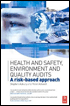
Health and Safety, Environment and Quality Audits
As we have seen, it is becoming increasingly important for all organizations to look at themselves with integrity and honesty, and with the responsibilities to all of their stakeholders in mind, through the reflection in the mirror that is presented to them by an audit of their management systems, and ask Do we have reasonable control of our operations ?
Chapter 2 provides a history of business control, and how the simplicity of the Deming Wheel has been supplemented by the complexity of subsequent control frameworks. Legal and stakeholder expectations for statutory and corporate governance have led to a variety of codes and standards for providing greater levels of assurance. Typically, the approach within any organization is hierarchical of course depending upon its size. At the highest level, this hierarchy begins with specific responsibilities for the corporate body and its executive directors, extends to the appointment of an audit committee which gains its independence by representation amongst its membership of external/non-executive directors, and the appointment of an internal audit manager. The internal audit manager is responsible for identifying and specifying a balanced mix of audit/assurance products in a rolling plan, and providing a flow of information to the audit committee for their consideration and action.
Reasonable control, in the context of this book, includes health, safety, environment and quality risks. Our methodology set out herein will show audit practitioners and those seeking to develop a career in auditing in step-by-step stages (just as a cookery recipe does)...