How to Cheat at Deploying and Securing RFID

For security professionals needing to get up and running fast with the topic of RFID, this guide offers the perfect approach to learning all that you need to adopt this security method.
 TABLE OF CONTENTS
 One of the oldest and most famous encryption algorithms is the Data Encryption Standard (DES), which was developed by IBM and the US government standard from 1976 until about 2001. The algorithm at the time was considered unbreakable and therefore was subject to export restrictions and then subsequently adapted by the US Department of Defense. Today companies that use the algorithm apply it three times over the same text, hence the name 3-DES.
DES was based significantly on the Lucifer algorithm invented by Horst Feistel, which never saw widespread use. Essentially, DES uses a single 64-bit key 56 bits of data and 8 bits of parity and operates on data in 64-bit chunks. This key is broken into 16 separate 48-bit subkeys, one for each round, which are called Feistel cycles. Figure 14.10 gives a schematic of how the DES encryption algorithm operates.
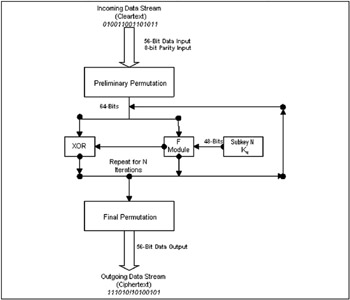
Each round consists of a substitution phase, wherein the data is substituted with pieces of the key, and a permutation phase, wherein the substituted data is scrambled (reordered). Substitution operations, sometimes referred to as confusion operations, are said to occur within S-boxes. Similarly, permutation operations, sometimes called diffusion operations, are said to occur in P-boxes. Both of these operations occur in the F module of the diagram. The security of DES lies mainly in the fact that since the substitution operations are nonlinear, the resulting cipher text in...