Local Area Networks: An Introduction to the Technology
By John E. McNamara
I
I
idling signal
Any signal applied to a communications line that indicates that no data is being sent. Such a signal is often used to reassure receiving stations that the line is still electrically intact and, in systems that recover clocking information from data, to keep the clock recovery circuits prepared for the arrival of data.
IEEE
The Institute of Electrical and Electronic Engineers, an information exchange, publishing, and standards-making body responsible for many standards used in local area networks, notably the 802 series.
impedance
An electrical property similar to resistance, but varying with frequency.
impedance discontinuity
A point at which the electrical properties of a transmission medium change, either because the medium itself has changed (different type of cable, for example) or because additional devices or sections of cable have been joined to the medium at that point. A change in impedance is important because when an electrical signal arrives at the point where the change occurs, a portion of that signals energy will be reflected back in the direction from which the signal arrived, possibly causing a malfunction.
interpacket gap
The time between the conclusion of the transmission (or reception) of one packet and the transmission (or reception) of the next.
intermediate system
Another name for router .
Internet (the)
A worldwide network of computer and communications facilities.
interrupt
A signal given to a computer that, when acknowledged, causes the computer to stop what it was doing (storing the details thereof) and turn its attention to the device...
Copyright Butterworth-Heinemann 1996 under license agreement with Books24x7
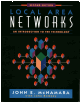
 TABLE OF CONTENTS