Microcontrollers in Practice

Packed with hundreds of practical examples and exercises to foster mastery of concepts and details, this practical guide provides readers with hands-on knowledge of how to implement three families of microcontrollers.
 TABLE OF CONTENTS
 This chapter contains the description of a simple development board based on the microcontroller 68HC11F1, and related software utilities, intended to allow the user to write and test software applications for this microcontroller.
A development system for the study of a microcontroller comprises a hardware module and a set of software utilities (cross-assembler, compiler, etc). Along with the data sheets and application notes from the manufacturer, this allows the user to reach a clear understanding of the resources and capabilities of that specific microcontroller, and to write and test software applications for it.
The module presented here is one of the simplest possible. It is built around the Motorola 68HC11F1 microcontroller, operating with an external EEPROM memory AT28C256, easily reprogrammable around 10 000 times. Test programs can be written directly to AT28C256 using a standard commercial EPROM programmer.
The 68HC11F1 microcontroller does not have internal program memory it is designed to work with external ROM in expanded mode. For this purpose, the microcontroller can provide up to four chip select signals for external memory or other I/O devices. The way these signals activate, their polarity and relative priority are software controlled. The schematic of the hardware module is presented in Fig. 9.1.
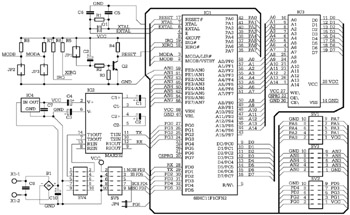
There are very few external components, besides the microcontroller. The program memory is connected directly to the address and data buses, and the chip select signal...