Microcontrollers in Practice
Packed with hundreds of practical examples and exercises to foster mastery of concepts and details, this practical guide provides readers with hands-on knowledge of how to implement three families of microcontrollers.
 TABLE OF CONTENTS
 This chapter is an introduction to the basic principles of control systems. It also contains a description of a didactic implementation of a PI temperature controller that uses the HC11 development board described in Chap. 9.
A control system is a system comprising physical and decisional elements, designed to control (to interferewith, to influence, to modify) a process.
In the classic example of a switch that controls an electric heater, the human operator has both decision and execution functions. A system where the intervention of a human operator is required is called manual control. If in this example the human operator is replaced by a time relay that switches the heater on and off at predetermined time intervals, the system becomes an automatic sequential system.
This system does not check whether the controlled heater actually produces heat, and the temperature of the environment does not influence the time relay. When the interaction between the control system and the controlled process is unidirectional, the control system is called an open-loop control system (see Fig. 14.1).
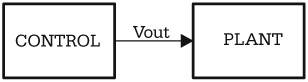
Open-loop control systems are often associated with manual control. Most automatic control systems have at least one active feedback loop which allows the system to evaluate the response of the controlled process and adjust the control action, so that the value of a controlled variable is maintained close to a set-point value. The general block diagram of...