Nanoscale Transistors: Device Physics, Modeling and Simulation

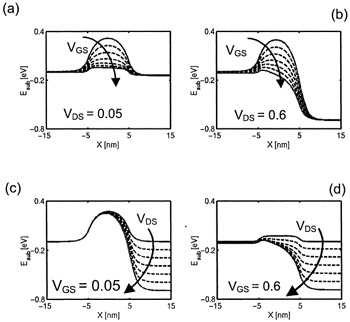
Silicon MOSFETs with channel lengths less than 10nm long have now been realized [3.1], and at such dimensions, our traditional understanding of transistors has to be questioned. In this chapter, we describe an approach to MOSFETs based on concepts that are widely-used in mesoscopic physics [3.2]. Figure 3.1 shows the lowest conduction subband energy vs. position along the channel of a 10nm MOSFET under a variety of gate and drain biases [3.3]. The figure shows that there is an energy barrier between the source and channel and that the gate voltage modulates the height of the barrier. The drain current increases as the barrier height is reduced by the increasing gate voltage (Fig. 3.1a for low drain bias and Fig. 3.1b for high drain bias). For an electrostatically well designed MOSFET, the gate bias controls the height of the source to channel barrier; the drain bias has a small effect (Figs. 3.1c and 3.1d). Because current flow is controlled by injection across a barrier, a MOSFET is similar to a bipolar transistor, except that in a bipolar transistor the barrier height is directly modulated by the emitter-base voltage while in the MOSFET it is modulated indirectly by the gate voltage [3.4]. Our theory of the nanoscale MOSFET will be based on this simple, physical picture.
Before proceeding, we should...