Nanoscale Transistors: Device Physics, Modeling and Simulation

A MOSFET-like CNTFET can be described by the same theory presented in Sec. 5.3 for semiconductor nanowires MOSFETs. The current is independent of bandstructure, so Eqn. (5.6) still applies. Equation (5.5) still describes the electrostatics, but to relate
and
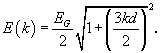
to the Fermi levels, we need to evaluate the sums, Eqns. (5.2a) and (5.2b) with the bandstructure of a carbon nanotube as given by Eqn. (5.50) and (5.51),
| (5.53) | |
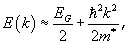
Near k = 0, we can expand the E( k) relation for small argument to find
| (5.54a) | |
where
| (5.54b) | |
or
| (5.54c) | |
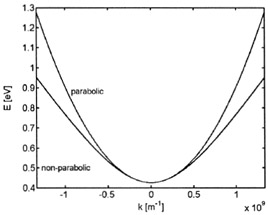
Unfortunately, the parabolic band assumption is not a good one for carbon nanotubes. Figure 5.19 compares the nanotube E( k) relation from Eqn. (5.50) with a parabolic band assumption using the effective mass from Eqn. (5.54) with d = 1 nm. The parabolic band approximation is valid only very near the energy minimum, but away from the minimum, E( k) is linear as in a metallic nanotube. The result is that analytical expression for n L has to be replaced by numerical integrations.
The I- V characteristics of the MOSFET-like CNTFET are described by Eqns. (5.5) and (5.6), which describe the electrostatics and transport. To evaluate the carrier density, we evaluate Eqn. (5.2a)
| (5.55) | |
where Eqn. (5.52) is used for the carbon nanotube...