Nanoscale Transistors: Device Physics, Modeling and Simulation

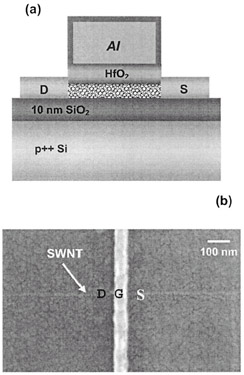
Nanowire transistors are rapidly advancing in terms of the sophistication of device structures and their performance metrics. At this time, it is hard to say where the research will lead. In this section, we will review one recent result, to illustrate where the current state-of-the-art in carbon nanotube FETs lies. Figure 5.23 shows a schematic cross section and a scanning electron micrograph (SEM) top view of a recently reported CNTFET [5.22]. The device has a carbon nanotube with a diameter of ~1.7 nm ( E G ~ 0.5 eV), a hafnium dioxide gate insulator with a high dielectric constant of ? ~ 16, and a metal gate that is self-aligned to the Pd source and drain contacts. Pd provides a low Schottky barrier to the valence band [5.23].
Figure 5.24 shows the measured I D vs. V DS characteristics of this device. For a power supply voltage of V DD = 0.4V, the on-current (at V DS = V GS = 0.4V) is quite high (~12 ?A). The obvious questions is: how does this compare to a MOSFET? Comparing the two transistors must be done very carefully, because comparisons are only meaningful if the threshold voltages (or leakage currents) are the same. More difficult is the fact that MOSFET currents are usually quoted per unit micrometer of width, because the...