Nanotechnology and Nanoelectronics: Materials, Devices, Measurement Techniques

Chapter 3: Nanodefects

3.1 Generation and Forms of Nanodefects in Crystals

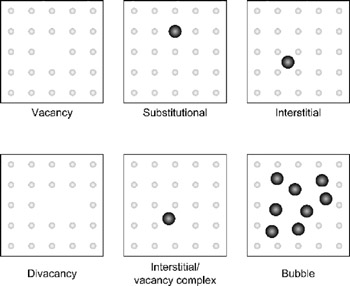
The most familiar type of nanostructures is probably the nanodefect. It has been known for a long time and has been the object of numerous investigations. Some nanodefects are depicted in Fig. 3.1.


Figure 3.1: Some nanodefects

Their first representative is the vacancy, which simply means the absence of a lattice atom (e.g., silicon). In the case of a substitutional defect, the silicon atom is replaced by a foreign atom that is located on a lattice site. A foreign atom can also take any other site; then we are dealing with an interstitial defect.

It is a general tendency in nature that a combination of two or more defects is energetically more favorable than a configuration from the contributing isolated defects. This means that two (or more) vacancies have the tendency to form a double vacancy, triple vacancy etc., since the potential energy of a double vacancy is smaller than that of two single vacancies. The same reason applies to the formation of a vacancy/interstitial complex. It turns out also that a larger number of vacancies can form a cavity in the crystal which can again be filled with foreign atoms so that filled bubbles are formed.

There is a long list of known defects; their investigation is worth the effort. Unfortunately, an in-depth discussion is beyond the scope of this book. Consequently, the interested reader is kindly referred to literature references such as [18] and [19] and quotations contained...

UNLIMITED FREE
ACCESS
TO THE WORLD'S BEST IDEAS

SUBMIT
Already a GlobalSpec user? Log in.

This is embarrasing...

An error occurred while processing the form. Please try again in a few minutes.

Customize Your GlobalSpec Experience

Category: Nanomaterials
Finish!
Privacy Policy

This is embarrasing...

An error occurred while processing the form. Please try again in a few minutes.