I. DISPLACEMENT EFFICIENCY
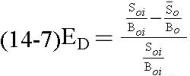
As defined previously, displacement efficiency is the fraction of movable oil that has been recovered from the swept zone at any given time. Mathematically, the displacement efficiency is expressed as:
or
where S oi = initial oil saturation at start of flood
B oi = oil FVF at start of flood, bbl/STB
 = average oil saturation in the flood pattern at a particular point during the flood
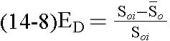
Assuming a constant oil formation volume factor during the flood life, Equation 14-7 is reduced to:
where the initial oil saturation Soi is given by:
However, in the swept area, the gas saturation is considered zero, thus:
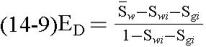
The displacement efficiency ED can be expressed more conveniently in terms of water saturation by substituting the above relationships into Equation 14-8, to give:
where  = average water saturation in the swept area
S gi = initial gas saturation at the start of the flood
S wi = initial water saturation at the start of the flood
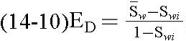
If no initial gas is present at the start of the flood, Equation 14-9 is reduced to:
The displacement efficiency E D will continually increase at different stages of the flood, i.e., with increasing  . Equation 14-8 or 14-10 suggests that ED reaches its maximum when the average oil saturation in the area of the flood pattern is reduced to the residual oil saturation S or or, equivalently, when
  = 1 - S or.
Example 14-4


 TABLE OF CONTENTS