Reservoir Engineering Handbook, Third Edition
To account for the reservoir vertical heterogeneity when predicting reservoir performance, the reservoir is represented by a series of layers with no vertical communication, i.e., no cross-flow between layers. Each layer is characterized by a thickness h, permeability k, and porosity ?. The heterogeneity of the entire reservoir is usually described by the permeability variation parameter V. Three of the methods that are designed to predict the performance of layered reservoirs are discussed below.
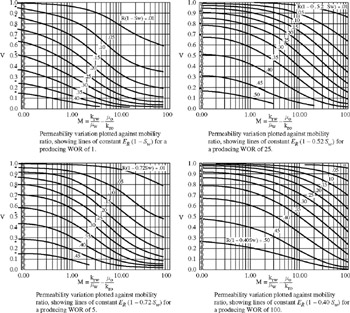
Dykstra and Parsons (1950) proposed a correlation for predicting waterflood oil recovery that uses the mobility ratio, permeability variation, and producing water-oil ratio as correlating parameters. Johnson (1956) developed a simplified graphical approach for the Dykstra and Parsons method that is based on predicting the overall oil recovery R at water-oil ratios of 1, 5, 25, and 100 bbl/bbl. Figure 14-54 shows the proposed graphical charts for the four selected WORs. The correlating parameters shown in Figure 14-54, are:
R = overall oil recovery factor
S wi = initial water saturation
M = mobility ratio
V = permeability variation
The practical application of the simplified Dykstra and Parsons method is outlined below:
Calculate the permeability variation V and mobility ratio M.
Using the permeability ratio and mobility ratio, calculate the overall oil recovery factor R from the four charts at WOR of 1, 5, 25, 100 bbl/bbl.