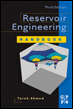
Reservoir Engineering Handbook, Third Edition
Accurate laboratory studies of PVT and phase-equilibria behavior of reservoir fluids are necessary for characterizing these fluids and evaluating their volumetric performance at various pressure levels. There are many laboratory analyses that can be made on a reservoir fluid sample. The amount of data desired determines the number of tests performed in the laboratory. In general, there are three types of laboratory tests used to measure hydrocarbon reservoir samples:
Primary tests These are simple, routine field (on-site) tests involving the measurements of the specific gravity and the gas-oil ratio of the produced hydrocarbon fluids.
Routine laboratory tests These are several laboratory tests that are routinely conducted to characterize the reservoir hydrocarbon fluid. They include:
Compositional analysis of the system
Constant-composition expansion
Differential liberation
Separator tests
Constant-volume depletion
Special laboratory PVT tests These types of tests are performed for very specific applications. If a reservoir is to be depleted under miscible gas injection or a gas cycling scheme, the following tests may be performed:
Slim-tube test
Swelling test
The objective of this chapter is to review the PVT laboratory tests and to illustrate the proper use of the information contained in PVT reports.
It is desirable to obtain a fluid sample as early in the life of a field as possible so that the sample will closely approximate the original reservoir fluid. Collection of a fluid sample early in the life of a field reduces the chances of free gas existing in...