Reservoir Engineering Handbook, Third Edition
The areal sweep efficiency E A is defined as the fraction of the total flood pattern that is contacted by the displacing fluid. It increases steadily with injection from zero at the start of the flood until breakthrough occurs, after which E A continues to increase at a slower rate.
The areal sweep efficiency depends basically on the following three main factors:
Mobility ratio M
Flood pattern
Cumulative water injected W inj
Pressure distribution between injectors and producers
Directional permeability
Correlations of sweep efficiency as a function of mobility ratio will be presented in a subsequent section for several well patterns. If directional permeability trends can be identified, injection and production wells can be arranged to take advantage of the trends to enhance areal sweep efficiency. It is also possible to maximize areal sweep through a careful management of pressure distribution and proper injection-production pattern selection.
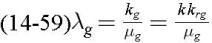
In general, the mobility of any fluid ? is defined as the ratio of the effective permeability of the fluid to the fluid viscosity, i.e.:
where ? o, ? w, ? g = mobility of oil, water, and gas, respectively
k o, k w, k g = effective permeability to oil, water, and gas, respectively
k ro, k rw = relative permeability to oil, water, and gas, respectively
k = absolute permeability
The fluid mobility as defined mathematically by the above three relationships indicates that ? is...