Artificial Intelligence Techniques in Power Systems
Since the early to mid 1980s much of the effort in power systems analysis has turned away from the methodology of formal mathematical modelling which came from the fields of operations research, control theory and numerical analysis to the less rigorous techniques of artificial intelligence (AI). Today the main AI techniques found in power systems applications are those utilising the logic and knowledge representations of expert systems, fuzzy systems, artificial neural networks (ANN) and, more recently, evolutionary computing. These techniques will be outlined in this chapter and the power system applications indicated.
One form of a knowledge-based system is an expert system. There is no standard definition of an expert system, but one which captures the spirit of this approach to problem solving is [1]
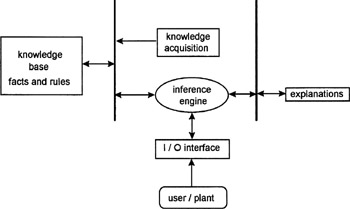
An expert system captures the knowledge of a human expert in a narrow specified domain in a machine implementable form. It utilises this (knowledge) to provide decision support at a level comparable to the human expert and is capable of justifying its reasoning. It separates the inference mechanisms from the domain specific knowledge and uses one or more knowledge structures such as production rules, frames, combinations of frames and rules, semantic nets, and objects to represent this knowledge.
This separation of parts is illustrated in Figure 1.1 where the domain knowledge is shown to be explicit and separate from the other knowledge in the program, e.g. in the reasoning structure.