Artificial Intelligence Techniques in Power Systems

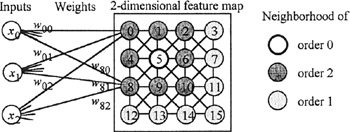
We will now show how the quantisation and the topological representation features of Kohonen's self-organising feature map can be applied to the static security assessment problem. The architecture and the unsupervised training of the Kohonen map are shown in Figure. 8.11. The terms Kohonen network and self-organising feature map are used as synonyms throughout this chapter.
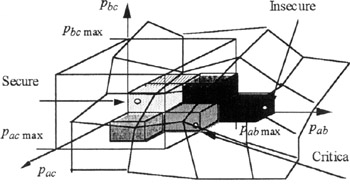
The first important feature of the self-organising map is the quantisation of the input space. The self-organising feature map segregates the operating space shown in Figure 8.4 into safe, critical and unsafe regions, as shown in Figure 8.8 and 8.12. The weight vectors of the neurons represent typical operating states which can be analysed off-line either statistically or with conventional power system analysis tools. In the ideal case, secure and critical states are classified by the neurons in the centre of the grid, and insecure states will be classified by the neurons at the border of the grid. The inner neurons will give quite precise quantitative information on the vulnerability of the system state with respect to security limit violations. The neurons at the border will give less precise information about the insecure operating states lying far away from the secure region. However, for these inadmissible operating points, remedial action should always be taken.
The second important feature of the Kohonen map is the...