Artificial Intelligence Techniques in Power Systems
In this chapter we outline a generic neuro-expert system (GENUES) architecture for hybrid reasoning. The architecture consists of five phases, namely, decomposition phase, control phase, decision phase, preprocessing phase, and postprocessing phase. The architecture is particularly applicable in time critical diagnostic/classification domains and data intensive domains in general. We describe the application of GENUES in a real time alarm processing system in a power system control centre.
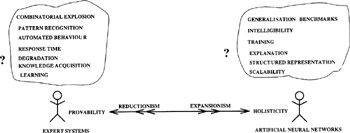
Artificial neural networks and expert systems are the two most widely used paradigms in intelligent systems for emulating one or more aspects of human cognition, namely information processing, knowledge representation and learning. These two paradigms also represent the dilemma faced by the intelligent systems community today with regard to use of symbolic (e.g. expert systems) and sub-symbolic (connectionist) paradigms (see Figure 11.1). The fact is that the stand alone applications of these two paradigms have exposed some of their limitations as shown in Figure 11.1. These limitations have been exposed especially with complex real world problems like alarm processing.
The problems associated with alarm processing include power system size, number of alarms during a system emergency, response time constraints, temporal reasoning, incomplete information and incorrect information [22]. The existing expert systems [5,6,12,13,20,34,38,39] approaches have been useful in addressing various issues related to alarm processing.
However, as stated by References 4 and 22 in their surveys on the practical use of expert systems, in power systems some of the...