Artificial Intelligence Techniques in Power Systems

Electricity demand forecasting within the National Grid Company (NGC) is carried out using various mathematical models. These models use comprehensive weather forecasts supplied by the UK Meteorological Office to provide short-term demand forecasts. These demand forecasts then become the vital input to schedule plant in merit order from 15 minutes to 36 hours ahead. Longer-term demand forecasts are also carried out for planning and business purposes up to five years ahead. The NGC is required to produce demand forecasts for operational, endurance and business planning in order to match generation output with demand.
The National Grid system operates at 400,000 volts (400 kV) and 275,000 volts (275 kV) and enables the transmission of electrical energy across England and Wales to the customer. The flexibility of the National Grid system enables the daily and seasonal variations in customer demand for electricity and changing patterns of generation to be satisfied.
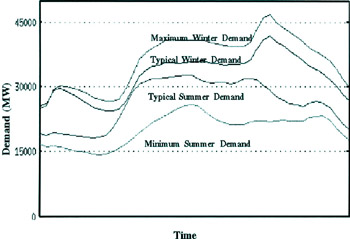
Demand for electricity from the National Grid exhibits large daily and seasonal variations, especially between winter and summer demands. The maximum winter demand can be more than twice that of the minimum summer demand as seen in Figure 12.1.
The daily pattern of demand has certain characteristic features. In winter, demand usually peaks at about 17:30 hours due to lighting up and tea time and again between 01:30 and 03:30 hours in the morning due to the heating associated with the...