Artificial Intelligence Techniques in Power Systems

The principal task of an electric power system is to deliver the power requested by the customers, without exceeding acceptable voltage and frequency limits. This task has to be solved in real time and in a safe, reliable, and economical manner.
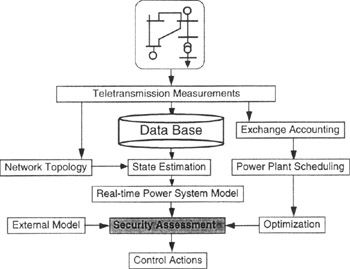
Figure 8.1 shows a simplified diagram of the principal data flow in a power system where real-time measurements are stored in a data base. The state estimation then adjusts bad and missing data. Based on the estimated value the current mathematical model of the power system is established. Based on simulation of potential equipment outages, the security level of the system is determined. If the system is considered unsafe with respect to one or more potential outages, control actions have to be taken.
In a power network, power flows are distributed on transmission lines according to Kirchhoff's laws. If the power flows violate material constraints concerning maximal currents tolerated by a line, or the maximal or minimal voltage tolerated by a transformer, the system can stay safely in this state only for a short period of time. Such critical situations often occur after an unforeseen line outage, for example because of a lightning stroke. Although rare events, outages leading to a partial or complete breakdown of the system, commonly referred to as brownouts and blackouts respectively, are extremely expensive. In July 1977, a blackout occurred in the State of New York as a consequence of two lightning...