Demystifying Switched-Capacitor Circuits

5.2: Performance Parameters of Data Converters

5.2 Performance Parameters of Data Converters

DAC Specifications

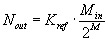
The fundamental function of a D/A converter (DAC) is to transform a digital word M in into an analog (or continuous) output signal N out (strictly speaking, the output is not truely continuous but has a finite number of distinct values), and the input-output relationship is given by

(5.1)

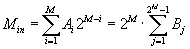
K ref is an analog reference whose dimension may be electric voltage, current, or charge. The digital input M in may be represented by either a binary (also called binary-weighted) code or a thermometer code, depending on the application's requirements; however, note that these two coding formats are interchangeable. The magnitude of M in can be expressed as

(5.2)

Here, A i's are the binary-code bits while B j's are the thermometer-code bits. In general, to represent 2 M different digital input values, a binary code only needs M bits, whereby a thermometer code needs up to (2 M - 1) bits. Table 5.1 compares a 3-bit binary code and the equivalent 7-bit thermometer code.

Table 5.1: Comparison chart: 3-bit binary versus 7-bit thermometer.

Binary Code

Thermometer Code

A 1

A 2

A 3

B 1

B 2

B 3

B 4

B 5

B 6

B 7

0

0

0

0

0

0

0

0

0

0

0

0

1

0

0

0

0

0

0

1

0

1

0

0

0

0

0

0

1

1

0

1

1

UNLIMITED FREE
ACCESS
TO THE WORLD'S BEST IDEAS

SUBMIT
Already a GlobalSpec user? Log in.

This is embarrasing...

An error occurred while processing the form. Please try again in a few minutes.

Customize Your GlobalSpec Experience

Category: Digital-to-Analog Converters
Finish!
Privacy Policy

This is embarrasing...

An error occurred while processing the form. Please try again in a few minutes.