Essential Linux
Good choice if you need help with Linux at the command line.
 TABLE OF CONTENTS
 Using terminal emulation programs, it is possible to access the Linux host as a terminal. It is also possible to exchange files using transfer protocols such as Kermit, which is installed on both the Linux system and the PC.
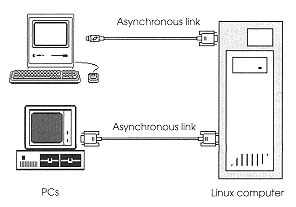
Although very simple, this approach does have some disadvantages. Each user needs a separate cable to the Linux system which, in turn, needs a dedicated serial port for each user. With a large number of PCs connected, the cabling can rapidly become unwieldy. Anyone who has seen 20 or more serial lines going into the back of a machine will immediately understand the problem. In addition, the serial line will only work over distances greater than 10 meters if special line drivers are used to boost the signal. This adds to the cost. Data transfer rates of about 9,600 to 38,000 baud are fine for updating a screen-but very slow for transferring data.
This solution is acceptable for small numbers of users who only need terminal access and the occasional ability to transfer files.
It is possible to use Ethernet to replace serial communication and improve data transfer rates, without having to implement a full traditional network, complete with networking software, and so on.
This is often done using TCP/IP and a set of associated utilities commonly referred to as Telnet. Telnet started out as a utility that ran on UNIX machine and allowed users to log into other UNIX machines or hosts that...