Handbook of Electrochemistry

Electrode surfaces are modified in a quest to render an electrochemical function either not possible or difficult to achieve using conventional electrodes. Targeted improvements include increased selectivity, sensitivity, chemical and electrochemical stability, as well as a larger usable potential window and improved resistance to fouling. Furthermore, electrodes with tailored surfaces enhance fundamental studies of interfacial processes. Therefore, the need for improved electrode performance and logically designed interfaces is rapidly growing in many areas of science.
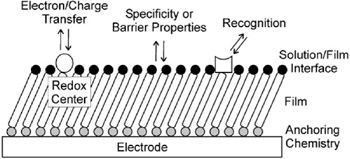
The definition of a chemically modified electrode (CME) is: a conducting or semiconducting material that has been coated with a monomolecular, multi-molecular, ionic, or polymeric film (termed adlayer; see Figure 8.1) which alter the electrochemical, optical, and other properties of the interface (1, 2). The conductive and semiconductive substrates are derived from conventional electrode materials (see Chapter 5), while the adlayers are widely diverse in their origins and properties. This diversity extends or enhances the range and scope of electrochemical techniques.
Ideally, the properties of the adlayer impart a predictable function to the electrode. Recent improvements in surface characterization techniques enable a molecular-levelunderstanding of modified interfaces. These techniques, coupled with electrochemical characterizations, not only provide a means to verify the function, but also serve as a basis for refinements of the modification strategy to further enhance its performance.