Handbook of Electrochemistry

Part Five: Data

CHAPTERS LIST

Chapter 18: Electrode Potentials
Chapter 19: Diffusion Coefficients
Chapter 20: Liquid Junction Potentials
Melissa D. Arning,
Department of Chemistry, Saint Louis University, 3501 Laclede Ave., St. Louis, MO 63103, USA
Shelley D. Minteer,
Department of Chemistry, Saint Louis University, 3501 Laclede Ave., St. Louis, MO 63103, USA

18.1 OVERVIEW

The beginning of the chapter is dedicated to charts of operating potential ranges for different solvent/electrolyte/electrode combinations. Operating potentials can act as a guide for determining the maximum and minimum potential to apply to a system. The second half of the chapter includes tables of electrode potentials of organic redox couples, inorganic redox couples, biological redox couples, drugs, vitamins, and neurochemicals. Electrode potentials can be used in conjunction with operating potential ranges to determine the optimal solution/electrode for monitoring a given redox species.

18.2 ESTIMATED POTENTIAL RANGES: AQUEOUS AND NON-AQUEOUS SOLUTIONS

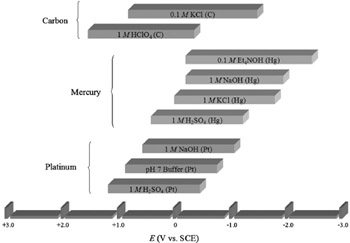
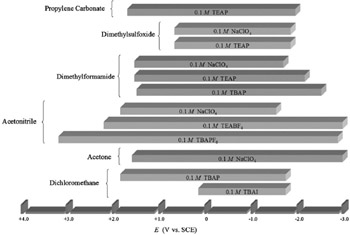
Figure 18.1 shows potential ranges (operating windows) for carbon, platinum, and mercury electrodes in aqueous solutions of common electrolytes. Figure 18.2 shows potential ranges (operating windows) for common organic solvents. Potential ranges are merely a guide and will vary with purity of solvent and electrolyte.


Figure 18.1: Estimated potential ranges in aqueous solutions at 25 C (for colour version: see colour section at the end of the book)

Figure 18.2: Estimated potential ranges at Pt electrodes for non-aqueous solvent/electrolyte solutions. Data from reference (1). (for colour version: see colour section at the end of the book)

18.3 STANDARD ELECTRODE POTENTIALS: AQUEOUS SOLUTIONS

Table 18.1 contains a selected list...

UNLIMITED FREE
ACCESS
TO THE WORLD'S BEST IDEAS

SUBMIT
Already a GlobalSpec user? Log in.

This is embarrasing...

An error occurred while processing the form. Please try again in a few minutes.

Customize Your GlobalSpec Experience

Category: Oxidation Reduction Potential (ORP) Instruments
Finish!
Privacy Policy

This is embarrasing...

An error occurred while processing the form. Please try again in a few minutes.