Handbook of Electrochemistry

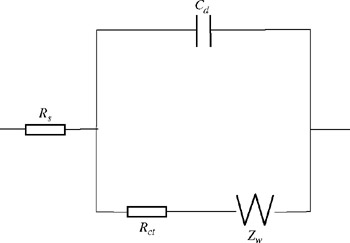
This chapter is concerned with measurements of kinetic parameters of heterogeneous elec-tron transfer (ET) processes (i.e., standard heterogeneous rate constant k and transfer coefficient) and homogeneous rate constants of coupled chemical reactions. A typical electrochemical process comprises at least three consecutive steps: diffusion of the reac-tant to the electrode surface, heterogeneous ET, and diffusion of the product into the bulk solution. The overall kinetics of such a multi-step process is determined by its slow step whose rate can be measured experimentally. The principles of such measurements can be seen from the simplified equivalence circuit of an electrochemical cell (Figure 15.1).
According to Figure 15.1, electrons can be transferred across the electrode/solution inter-face via two parallel pathways, i.e., the faradaic process, which is represented by the charge transfer resistance and diffusion (Warburg) impedance connected in series, and the charging/ discharging of the electrical double layer. In both cases, the current flows through solution, which is represented by the ohmic resistance R s. The second pathway is important...