5.4 OSCILLATORS
Current conveyors can be also successfully used in the design of oscillators. In fact, they have shown to provide wider bandwidth and a best accuracy with respect to the traditional op-amps. Moreover, they do not present a serious disadvantage of op-amp based oscillators. In fact, it has been proved [34] that the limitation of the finite GBW product affects the frequency oscillation as well as the oscillation condition. For this reason, CCII-based oscillators have been proposed in the literature since more than 20 years ago [35], [36], [37].
Anyway, in signal processing a wide number of voltage-mode solutions have been developed. That's why it is not unusual to find transformation methods that allow to obtain a current-mode solution from its voltage-mode counterpart [38], [39], [40], [41]. An example of this approach is constituted by the design of a Wien oscillator, whose solution using a VCVS as amplifier block in a Wien bridge is shown in figure 5.49 [41].
The design equations for this oscillator are the following:
being K the VCVS voltage gain.
We can consider R 1 as a part of the active block; in this case the VCVS is replaced by a VCCS, whose gain is K/R 1. Using different solutions for the VCCS implementation, different expression of the gain have to be considered.
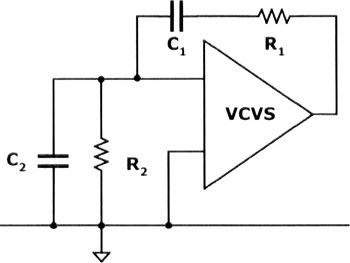 Figure 5.49: Wien Oscillator scheme
 CCIIs can be employed in the design of any kind of active block, then other CCII-based...


 TABLE OF CONTENTS