Low-Voltage, Low-Power CMOS Current Conveyors

Current conveyors, being an alternative to the classical operational amplifier, can be employed with success in an extremely wide range of different applications. In chapter 4 we have shown how the basic CCII can be used as building block in designing more complicated conveyors topologies. In this section we present some applications of current conveyors.
One of the basic characteristics of a current conveyor is represented by its X node impedance. Ideally this impedance should be zero, but in non-ideal circuits its non-zero value has to be taken into account. In the previous sections we have shown how this parasitic impedance gives an error in the designed analog functions, even if this problem can be overcome by avoiding loads whose value is comparable to that of the parasitic impedance.
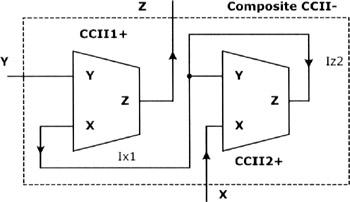
A possible solution to this problem can be represented by the circuit in fig. 5.64, where two positive current conveyors are employed to obtain a negative current conveyor, highlighted into the dotted lines, so showing a low parasitic impedance at X node [51].
In fact, when a voltage is applied to the Y node of the first CCII and a load is connected to the X node of the second CCII, it follows that I x1 = I z2 = ? 2 I x2. Then, the parasitic equivalent impedance between X and Y is equal to...