OVERVIEW
Consider the following membrane stream juxtaposition, by analogy with a phase separation, as diagrammed in Figure 3.1. The conditions and compositions for each stream do not change with position; the circumstance is called perfect mixing, and the conditions and compositions do not change with time, signifying a steady state.
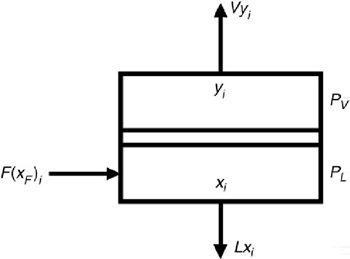 Figure 3.1: Single-stage membrane separation with perfect mixing
 The mole fraction compositions y i and x i are therefore uniform on each side of the membrane, where the subscript i denotes components 1, 2, 3, , k. The respective steady-state molar stream rates are denoted F, L, and V. These may designate the total flow rate of the each stream or be a flux rate based on the membrane area.
Stream F denotes the feed, stream V the permeate, and stream L the reject. Ordinarily, all phases are to be gaseous, but alternately all may be liquids; that is, no phase separations per se are involved. Furthermore, the system is nonreacting. The kinds of calculations involved are presented in a number of references, as applicable to phase separations, at equilibrium, between liquids and gases or vapors. [1], [2], [3], By a fortuitous circumstance in the representations, the same methodology can be applied to membrane separations.
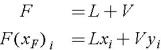
The material balances are
where
Furthermore,
whereby
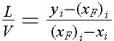
or
This is a straight line in y i-x i space, with the slope (- L/ V) and the

 TABLE OF CONTENTS