Membrane Separations Technology: Single-Stage, Multistage, and Differential Permeation
Chapter 7: Countercurrent Flow with Recycle

OVERVIEW

The preceding chapter shows that, for the limiting conditions of countercurrent flow with no reject produced, the less-permeable component hypothetically could concentrate in the far end of the reject side of the cell. Similarly, with no net permeate produced and compression from the permeate side to the reject side, it is theoretically conceivable for the more-permeable component to concentrate in the far end of the permeate side of the cell.

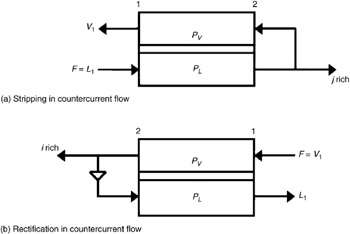
In practice, these conditions could be accented by the use of recycle, in the first instance part (or all, in the limit) of the reject, and the operation may be regarded as "stripping." In the second instance, part (or all, in the limit) of the permeate on the low-pressure or permeate side is compressed and recycled to the high-pressure or reject side, and the operation may be regarded as "rectification." The two situations are diagrammed and compared in Figure 7.1.


Figure 7.1: Use of recycle in countercurrent flow. w

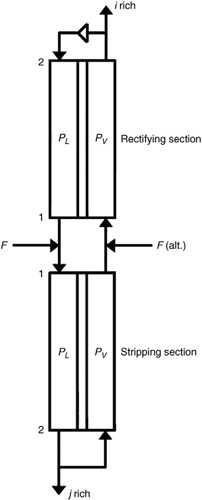
Both stripping and rectification may be combined, as shown in Figure 7.2, to produce a sharper separation. The overall operation then corresponds to a distillation column, such as a packed or wetted-wall column, which can be described in terms of a continuum. [1] In distillation and in absorption and stripping, the calculation methodology is to assume constant internal flow rates, which in general does not apply here but can be utilized as a workable simplification.


Figure 7.2: Combined stripping and rectification

Each section (the stripping section and the rectifying...

UNLIMITED FREE
ACCESS
TO THE WORLD'S BEST IDEAS

SUBMIT
Already a GlobalSpec user? Log in.

This is embarrasing...

An error occurred while processing the form. Please try again in a few minutes.

Customize Your GlobalSpec Experience

Category: Tower Packing
Finish!
Privacy Policy

This is embarrasing...

An error occurred while processing the form. Please try again in a few minutes.