Microsoft .NET: Jumpstart for Systems Administrators and Developers

This book focuses on actual implementation and management issues critical to the success of an enterprise.
 TABLE OF CONTENTS
 Without exception, every time we build a .NET solution, SQL Server will figure somewhere in the architecture owing to the requirement to persist or permanently store data in a structured format somewhere along the line. This can range from state and session information to storing product information from Microsoft Commerce Server 2002.
Many of the Microsoft .NET Enterprise Server products will use SQL Server by default. In some cases you could possibly switch this to Oracle or another database, but that would generally be more trouble than it s worth. Because of this, Microsoft SQL Server is becoming increasingly prevalent throughout many organizations.
Microsoft SQL Server comprises a number of areas of functionality, including the following:
Relational Database This is the SQL Server database engine and is where all of the data is stored in table-based structures. Data access is controlled by the relational database engine, and the clever use of indexes and data structures in this area increases the speed at which data can be retrieved (see Figure 6.1).
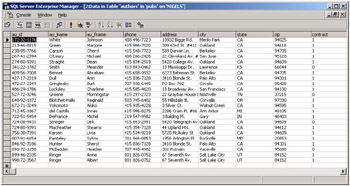
Figure 6.1: Typical view of data stored in SQL Server.
Administration Managing and controlling the database is done via the Enterprise Manager, which sits in the Microsoft Management Console application. Microsoft has done a fair bit of work in making the database as easy as possible to manage, and every task, such as backups, table creation, replication, and disk management, can now be completed from this interface. In the past, database administrators (DBAs) would have used the...