Microsoft .NET: Jumpstart for Systems Administrators and Developers

This book focuses on actual implementation and management issues critical to the success of an enterprise.
 TABLE OF CONTENTS
 Content management is the process of ensuring that a Web site contains relevant up-to-date material. The content needs to be created and submitted securely, with appropriate business approval, to ensure that it is suitable for use on a company s site. As well as attracting bad publicity, inaccurate content can lead to legal problems.
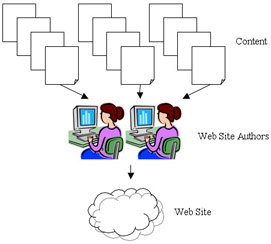
The need for content management came about soon after organizations built their own Web sites and realized that they needed an army of HTML authors just to keep the site up-to-date. As the number of Web site pages increased, so did the number of HTML authors since the process of designing and managing Web pages is fairly labor intensive. Clearly, this was impractical, and the costs of such an operation were becoming too much for many organizations to bear (see Figure 7.1).
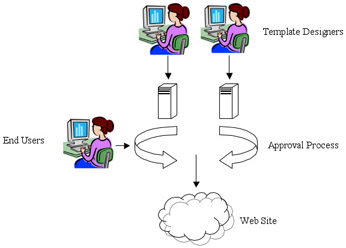
A number of organizations built home grown-solutions, some using products such as Microsoft Access and SQL Server. The site content would be typed into the database and then linked from the database to the site. This worked well and continues to provide a level of content management to some companies today. As you would expect, the dot-com boom led to a huge demand for proper content management solutions, and a number of companies started up providing just such a service (see Figure 7.2).