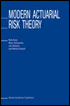
Modern Actuarial Risk Theory

Chapter 8: Generalized Linear Models

8.1 INTRODUCTION

In econometrics, the most widely used statistical technique is multiple linear regression. Actuarial statistics models situations that do not always fit in this framework. Regression assumes normally distributed disturbances with a constant variance around a mean that is linear in the collateral data. In actuarial applications, a symmetric normally distributed random variable with a fixed variance does not adequately describe the situation. For counts, a Poisson distribution is generally a good model, if the assumptions of the Poisson processes such as described in Chapter 4 are valid. For these random variables, the mean and variance are the same, but the data sets encountered in practice generally exhibit a variance greater than the mean. A distribution to describe the claim size should have a thick right-hand tail. Rather than a variance not depending of the mean, one would expect the coefficient of variation to be constant. Furthermore, the phenomena to be modelled are rarely additive in the collateral data. A multiplicative model is much more plausible. Moving from downtown to the country, or replacing the car by a car 200 kilograms lighter, without changing other policy characteristics, would result in a reduction in the average total claims by some fixed percentage of it, not by a fixed amount independent of the original risk.

Both these problems can be solved by not working with ordinary linear models, but with Generalized Linear Models (GLM). The generalization is twofold. First, it is allowed that the random deviations from the mean obey another...

UNLIMITED FREE
ACCESS
TO THE WORLD'S BEST IDEAS

SUBMIT
Already a GlobalSpec user? Log in.

This is embarrasing...

An error occurred while processing the form. Please try again in a few minutes.

Customize Your GlobalSpec Experience

Category: Checkweighers
Finish!
Privacy Policy

This is embarrasing...

An error occurred while processing the form. Please try again in a few minutes.