Power Systems Electromagnetic Transients Simulation
7.2: Basic Transformer Model

7.2 Basic Transformer Model

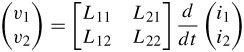
The equivalent circuit of the basic transformer model, shown in Figure 7.1, consists of two mutually coupled coils. The voltages across these coils is expressed as:

(7.1)

where L 11 and L 22 are the self-inductance of winding 1 and 2 respectively, and L 12 and L 21 are the mutual inductance between the windings.


Figure 7.1: Equivalent circuit of the two-winding transformer

In order to solve for the winding currents the inductance matrix has to be inverted, i.e.

(7.2)

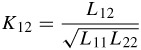
Since the mutual coupling is bilateral, L 12 and L 21 are identical. The coupling coefficient between the two coils is:

(7.3)

Rewriting equation 7.1 using the turns ratio ( a = v 1/ v 2) gives:

(7.4)

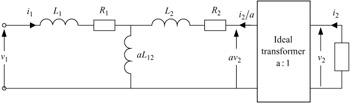
This equation can be represented by the equivalent circuit shown in Figure 7.2, where

(7.5)
(7.6)

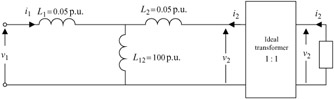
Consider a transformer with a 10% leakage reactance equally divided between the two windings and a magnetising current of 0.01 p.u. Then the input impedance with the second winding open circuited must be 100 p.u. (Note from equation 7.5, L 1 + L 12 = L 11 since a = 1 in the per unit system.) Hence the equivalent in Figure 7.3 is obtained, the corresponding equation (in p.u.) being:

(7.7)

or in actual values:

(7.8)

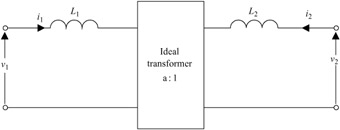
Figure 7.2: Equivalent circuit of the two-winding transformer, without the magnetising branch

Figure 7.3: Transformer example

7.2.1 Numerical Implementation

Separating equation 7.2 into...

UNLIMITED FREE
ACCESS
TO THE WORLD'S BEST IDEAS

SUBMIT
Already a GlobalSpec user? Log in.

This is embarrasing...

An error occurred while processing the form. Please try again in a few minutes.

Customize Your GlobalSpec Experience

Category: Single Phase Transformers
Finish!
Privacy Policy

This is embarrasing...

An error occurred while processing the form. Please try again in a few minutes.