Power Systems Electromagnetic Transients Simulation
The synchronous machine model to be used in each case depends on the time span of interest. For example the internal e.m.f. behind subtransient reactance is perfectly adequate for electromagnetic transients studies of only a few cycles, such as the assessment of switching oscillations. At the other extreme, transient studies involving speed variations and/or torsional vibrations need to model adequately the generator rotor and turbine rotor masses. Thus a general-purpose model should include the generator electrical parameters as well as the generator and turbine mechanical parameters.
All the models used in the various versions of the EMTP method are based on Park's transformation from phase to dq0 components [18], a frame of reference in which the self and mutual machine inductances are constant. Although a state variable formulation of the equations is used, their solution is carried out using the numerical integrator substitution method.
In the EMTDC program the machine d and d axis currents are used as state variables, whereas fluxes are used instead in the EMTP program [19].
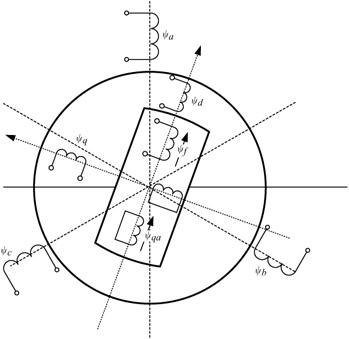
Figure 7.16 depicts a synchronous machine with three fixed windings and one rotating winding (at this point the damping windings are not included). Let ?( t) be the angle between the field winding and winding a at time t. From Faraday's law:
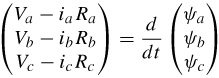
| (7.50) | |
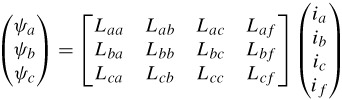
where
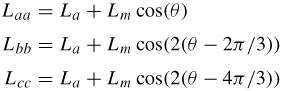
The inductances are of a time varying nature, e.g.
| (7.51) | |
Assuming a sinusoidal winding...