Power Systems Electromagnetic Transients Simulation

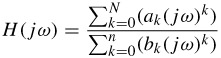
The rational function in s to be fitted to the frequency domain data is:
| (B.1) | |
where N ? n.
The frequency response of equation B.1 is:
| (B.2) | |
where b 0 = 1.
Letting the sample data be c( j ?) + jd( j ?), and equating it to equation B.2 yields
| (B.3) | |
or
| (B.4) | |
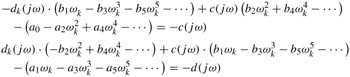
Splitting into real and imaginary parts yields:
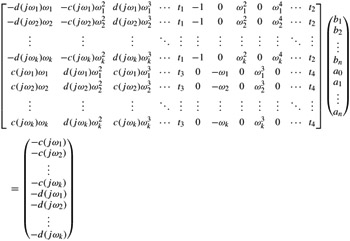
This must hold for each sample point and therefore assembling into a matrix equation gives
| (B.5) | |
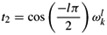
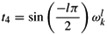
where the terms t 1, t 2, t 3, and t 4 are
l = column number
k = row or sample number.
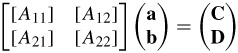
Equation B.5 is of the form:
| (B.6) | |
where
| a T | = ( a 0, a 1, a 2, a 3, ..., a n) |
| b T | = ( b 1, b 2, b 3, ..., b n) |
| C T | = (- c( j ? 1), - c( j ? 2), - c( j ? 3), ..., - c( j ? k)) |
| D T | = (- d( j ? 1), - d( j ? 2), - d( j ? 3), ..., - d( j ? k)) |
Equation B.6 is solved for the required coefficients ( a's and b's).
The rational function...