Power Systems Electromagnetic Transients Simulation

Appendix E: Developing Difference Equations

E.1 Root-matching Technique Applied to a First Order Lag Function

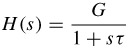
This example illustrates the use of the root-matching technique to develop a difference equation as described in section 5.3. The first order lag function in the s-domain is expressed as:


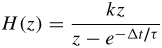
The corresponding z-domain transfer function with pole matched (as z = e s ? t) is


Applying the final value theorem to the s-domain transfer function

Lin s ?0 [ s H( s)/ s} = G

Applying the final value theorem to the z-domain transfer function


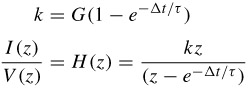
Therefore


Rearranging gives:

I( z) ( z - e -? t / ?)

= kzV( z)

I( z) (1 - z -1 e -? t / ?)

= kV( z)

Hence

I( z) = kV( z) + e -? t / ?z -1 I( z)

or in the time domain the exponential form of difference equation becomes:

(E.1)

E.2 Root-matching Technique Applied to a First Order Differential Pole Function

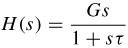
This example illustrates the use of the root-matching technique to develop a difference equation as described in section 5.3, for a first order differential pole function. The s-domain expression for the first order differential pole function is:


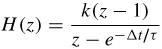
The z-domain transfer function with pole and zero matched (using z = e s ? t) is


Applying the final value...

UNLIMITED FREE
ACCESS
TO THE WORLD'S BEST IDEAS

SUBMIT
Already a GlobalSpec user? Log in.

This is embarrasing...

An error occurred while processing the form. Please try again in a few minutes.

Customize Your GlobalSpec Experience

Category: IC Electronic Filters
Finish!
Privacy Policy

This is embarrasing...

An error occurred while processing the form. Please try again in a few minutes.