Power Systems Electromagnetic Transients Simulation
Traditionally the simulation of transient phenomena in real time has been carried out on analogue simulators. However their modelling limitations and costly maintenance, coupled with the availability of cheap computing power, has restricted their continued use and further development. Instead, all the recent development effort has gone into digital transient network analysers (DTNA) [1], [2].
Computing speed by itself would not justify the use of real-time simulation, as there is no possibility of human interaction with information derived in real time. The purpose of their existence is two-fold, i.e. the need to test control [3], [4] and protection [5] [8] equipment in the power network environment and the simulation of system performance taking into account the dynamics of such equipment.
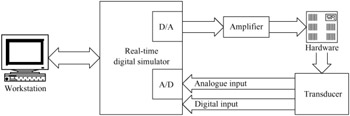
In the 'normal' close-loop testing mode, the real-time digital simulator must perform continuously all the necessary calculations in a time step less than that of actual time. This allows closed-loop testing involving the actual hardware, which in turn influences the simulation model, as indicated in Figure 13.1. Typical examples of signals that can be fed back are the relay contacts controlling the circuit breaker in simulation and the controller modifying the firing angle of a converter model.
The processing power required to solve the system equations in real time is immense and the key to achieving it with present computer technology is the use of parallel processing. Chapter 4 has shown that the presence of transmission lines (with a travelling wave time...