Risk Analysis in Building Fire Safety Engineering

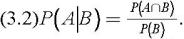
For any two events A and B such that P( B) ? 0 , the conditional probability of event A given that event B has occurred is denoted by P( A B) and is defined by
Example Consider example 1 in Section 3.3. Denote the four possible situations (in an obvious way) by DCWC, DOWO, DOWC and DCWO. Suppose, as before, that the probabilities of these events are 0.1, 0.2, 0.4 and 0.3, respectively. Let us note that in reality there are four elementary events: DC, DO, WC, WO and that we can write DCWC as DC ? WC and so on.
It then follows from Theorem 3.3.2 that, since clearly WO = WC C,
Similarly, P( DO) = 0 .2 + 0 .4 = 0 .6.
We can now ask: among all the compartments which had the door closed, what was the probability (i.e. relative frequency) of open windows? This is exactly what is meant by the probability of an open window, given that the door is closed, namely P( WO DC). Using the formula of Definition 3.4.1, we obtain: