Risk Analysis in Building Fire Safety Engineering

Mathematical expectation is an averaging process on a random variable, with the weights being the probabilities of the various outcomes occurring. The expected value of a random variable X is denoted by E( X). It is also known simply as the expectation or mean of X. The concept of expectation is similar to the concept of centre of gravity in mechanics.
Examples
Consider the discrete random variable X introduced in Section 3.7.2, which represents the number of children among three occupants of a room. The probability function of X is given in Table 3.2.
The expected value of X is given by
Thus the average ( expected ) number of children in the room is 0.9.
In general, if X is a discrete random variable with probability function f( x) then the expected value E( X) is given by
If, on the other hand, X is a continuous random variable with probability density function f( x):
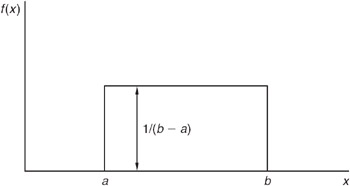
Consider the uniform probability density function over ( a, b) (Figure 3.10):
Figure 3.10: Uniform probability density function.
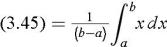
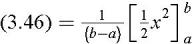
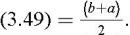
We have
i.e. the mean of X is at the midpoint of ( a, b), as would be expected from considerations of symmetry. In general, the mean of a random variable whose p.d.f. is symmetric about some point x 0 is at x 0.
The above definition readily...