Subsea Pipelines and Risers

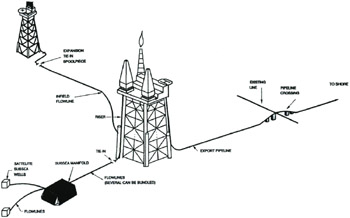
Pipelines (and risers) are used for a number of purposes in the development of offshore hydrocarbon resources (see Figure 1.1). These include e.g.:
Export (transportation) pipelines;
Flowlines to transfer product from a platform to export lines;
Water injection or chemical injection flowlines;
Flowlines to transfer product between platforms, subsea manifolds and satellite wells;
Pipeline bundles.
The design process for each type of lines in general terms is the same. It is this general design approach that will be discussed in this book.
Design of metallic risers is similar to pipeline design, although different analysis tools and design criteria are applied. Part IV of this book is devoted to riser design.
Finally, in Chapter 16, two pipeline design projects are used as examples demonstrating how technical development described in this book is used to achieve cost saving and safety/quality.
The design of pipelines and risers is usually performed in three stages, namely;
Conceptual engineering,
Preliminary engineering or pre-engineering,
Detail engineering.
The objective and scope of each of these design stages vary depending on the operator and the size of the project. However, the primary aims are generally as follows (Langford and Kelly (1990)):
Conceptual Engineering
The primary objectives are normally:
To establish technical feasibility and constraints on the system design...