Subsea Pipelines and Risers

In principle, reliability-based design of offshore pipelines involves the following aspects:
Identification of failure modes for specified design cases;
Definition of design formats and Limit State Functions (LSF);
Uncertainty measurements of all random variables;
Calculation of failure probability;
Determination of target reliability levels;
Calibration of safety factors for design;
Evaluation of design results.
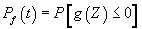
Generally, limit-state function (LSF) is introduced and denoted by g(Z) where Z is the vector of all uncertainty variables. Failure occurs when g(Z) ?0. For a given LSF g(Z), the probability of failure is defined as:
| (37.1) | |
The results can also be expressed in terms of a reliability index ?, which is uniquely related to the failure probability by:
| (37.2) | |
where ?(.) is standard normal distribution function.
Two general approaches are available to solve Equation (37.1) namely analytical and simulation methods respectively, see Bai (2003).
Considering uncertainties involved in the design format, each random variable X i can be specified as:
| (37.3) | |
where X C is the characteristic value of X i, and B X is a normalized variable reflecting the uncertainty in X i.
Usually, the determination of the distribution...