Subsea Pipelines and Risers

Part V: Welding and Installation

Chapter List

Chapter 32: Use of High Strength Steel
Chapter 33: Welding and Defect Acceptance
Chapter 34: Installation Design
Chapter 35: Route Optimization, Tie-in and Protection
Chapter 36: Pipeline Inspection, Maintenance and Repair

32.1 Introduction

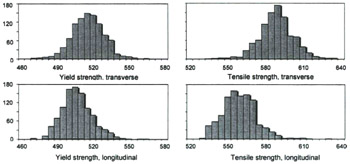
The research and development of new steels are for both sour and non-sour service. The materials being developed for subsea pipelines and risers are grades X70 and X80 for non-sour service and grades X65 and X70 with a wall thickness of up to 40 mm for sour service. Figure 32.1 shows, by way of example, the distribution curves determined on a production lot of grade X65 pipe intended for sour service. As can be seen, the distributions for the transverse direction are shifted to the right relative to those for the longitudinal direction. In this Chapter, we shall review use of high strength steel for subsea pipelines, technological challenges and solutions.


Figure 32.1: Results on 610 mm OD x 14.3 mm W.T. X65 production linepipe for sour service.

32.2 Review of Usage of High Strength Steet Linepipes

32.2.1 Usage of X70 Linepipe

32.2.1.1 General

For offshore pipelines, the current trend is towards linepipe in grade X70 with a wall thickness up to 40 mm. Fulfillment of the requirements for DWTT transition temperature will be progressively difficult as the wall thickness increases. For wall thickness in excess of 30 mm, low transition temperatures can only be achieved by means of highly expensive rolling processes. Until now, there has been only limited offshore use of X70 material.

UNLIMITED FREE
ACCESS
TO THE WORLD'S BEST IDEAS

SUBMIT
Already a GlobalSpec user? Log in.

This is embarrasing...

An error occurred while processing the form. Please try again in a few minutes.

Customize Your GlobalSpec Experience

Category: Drill Pipe
Finish!
Privacy Policy

This is embarrasing...

An error occurred while processing the form. Please try again in a few minutes.