Bifurcation And Chaos In Nonsmooth Mechanical Systems, Series A, Vol. 45

This book presents the theoretical frame for studying lumped nonsmooth dynamical systems, containing the mathematical methods, and adapted numerical methods.
 TABLE OF CONTENTS
 In this section we intend to build numerical schemes that are well-adapted to dynamical equilibrium and that can be described by differential inclusions (or by ordinary differential equations and differential inclusions in the case of determined or stochastic case). Let us assume that existence and uniqueness results are obtained for all the mathematical problems considered in this chapter. First we deal with practical formulations of these numerical schemes without rigorous applied mathematical background. We often give the references where these mathematical questions are resolved. Many other numerical schemes can be built: based on classical numerical methods (see e.g. section 4.2) they are not adapted to very general cases as the next ones. But they are also commonly used and they can be efficient.
Let us consider a dynamical system described by the following differential inclusion of first order with initial conditions:
| (3.1) | 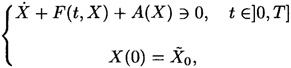 |
with T>0, X: [0, T] ? E the (un)known exact unique vector function solution defined from interval [0, T] to (finite or infinite dimensional) vector space E; F is a smooth function of t and X. A is a maximal monotone graph (or operator) on E for a given scalar product ( , ).  is a given vector in E (initial condition).
In order to build numerical schemes, we introduce a discretization of [0, T] using time t 0=0, t 1, t