Bifurcation And Chaos In Nonsmooth Mechanical Systems, Series A, Vol. 45
This book presents the theoretical frame for studying lumped nonsmooth dynamical systems, containing the mathematical methods, and adapted numerical methods.
 TABLE OF CONTENTS
Properties of numerical schemes for discrete (and even more general) systems including friction or elastoplastic terms have been studied in [Bastien (2000)], [Bastien and Schatzman (1999)] and [Bastien and Schatzman (2000)]. Let us recall the main results, adapted from these two last references. Let H be a separable Hilbert space with the scalar product ( , ) and norm . Let us consider the problem:
| (4.1) |  |
with
| (4.2) | 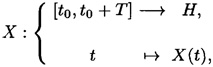 |
where B is a Lipschitz-continuous operator and, H is an elliptic one, i.e.:
| (4.3) |  |
and
| (4.4) |  |
A is a maximal monotone operator on H with bounded section A 0, and
| (4.5) | 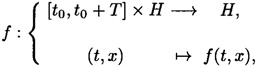 |
is Lipschitz-continuous on H, i.e.
| (4.6) |  |
and
| (4.7) |  |
The map
| (4.8) | 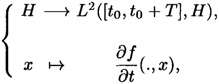 |
is bounded in L 2([ t 0, t 0+ T], H) on every compact subset of H. Then, existence and uniqueness results have been obtained in [Brezis (1973)] and the following numerical scheme [Bastien and Schatzman (2000)] with constant time step h>0 can be used in order to approximate the exact solution X(t) of (4.1):
| (4.9) | 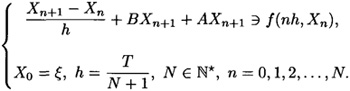 |
It is proved in [Bastien (2000)] or [Bastien and Schatzman (1999)] (and an idea of proof is given in [Bastien and Schatzman (2000)]) that this numerical scheme is of order 1/2, i.e., it verifies:
| (4.10) |  |
where  is the function defined by linear interpolation of X nh.
In many physical situations as we already explained, A derives...