Bifurcation And Chaos In Nonsmooth Mechanical Systems, Series A, Vol. 45
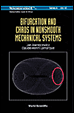
This book presents the theoretical frame for studying lumped nonsmooth dynamical systems, containing the mathematical methods, and adapted numerical methods.
 TABLE OF CONTENTS
 In the literature, many studies about the behaviour of nonlinear models can be found within the last twenty years. Brogliato [Brogliato (1996)] and Palmov [Palmov (1998)] give in their respective books numerous nonlinear mechanical models. Among these models, we are interested in those involving friction laws.
Authors especially study mechanical models with a finite number of degrees of freedom involving frictions terms and submitted to dynamical solicitations. Some of these papers provide mathematical results of existence and uniqueness [Jean and Pratt (1985); Laghdir and Monteiro Marques (1995); Monteiro Marques (1994); Matrosov and Finogenko (1995); Matrosov and Finogenko (1996b); Matrosov and Finogenko (1996a); Trinkle et. al. (1997)]. Some others investigate physical behaviours without dealing with theoretical results: some works present friction laws issued from experiments [Anderson and Ferri (1990)] and [Ferri and Bindemann (1995)]; stick-slip phenomena is the main topic investigated in the references [Awrejcewicz and Delfs (1990a); Awrejcewicz and Delfs (1990b); Baumberger et. al. (1995); Ionescu and Paumier (1993); Pratt and Williams (1981)] and [Stelter (1992)]. The study of friction may be based upon analytical calculation of solutions [Capecchi and Vestroni (1995)]. Some works describe experiments, identification and modelling of friction [Dowell and Schwartz (1983a); Dowell and Schwartz (1983b)] and [Tomlinson and Chen (1996)]. Numerical experiments have been made by many authors using classical numerical schemes [Stewart (1996); Stewart and Trinkle (1996)] and [Stewart and Trinkle (1997)]. Chaotic behaviour have been exhibited by nonlinear models including friction [Chua et. al.