Bifurcation And Chaos In Nonsmooth Mechanical Systems, Series A, Vol. 45
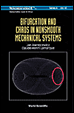
This book presents the theoretical frame for studying lumped nonsmooth dynamical systems, containing the mathematical methods, and adapted numerical methods.
 TABLE OF CONTENTS
 Analysis of the response of structures is convenient if a linear model can fully describe the structure. In this frame, it is useful to introduce in a finite or infinite dimension (Hilbertian case) the notion of eigenmodes of the structure. They are either normal modes (defined by adding conservative conditions to the model) or complex modes (taking into account viscous damping for example) [Caughey (1965); Meirovitch (1967)]. The linear theory of differential systems provides the response of the structure to an external elementary sinusoidal solicitation under an interesting form: The full response is simply the superposition of the responses of each mode to the solicitation. Such a formula is well known; this is the superposition formula which is the basis of modal synthesis [J z quel (1985); Meirovitch (1967)]. The notion of modal synthesis can be extended to the case of substructures by using linear operator theory [Bourquin (1991); J z quel (1985)].
In the nonlinear case, the notion of nonlinear modes had been considered first. In the case of mathematically smooth nonlinearities and for a finite number of degrees of freedom with particular polynomial nonlinearities, Rosenberg first introduced natural modes [Rosenberg and Atkinson (1959)] and then nonlinear normal modes [Pak and Rosenberg (1968)], [Rosenberg (1961); Rosenberg (1962); Rosenberg (1964)], and investigated their stability. Until now, many methods have been used to introduce modes (natural, nonlinear, nonlinear normal, minimal normal, nonlinear similar normal, etc.) in the case of nonlinear structures: Methods derived from the works of Rosenberg [Anand (1972); Cooke and Struble...