Encyclopedia and Handbook of Process Capability Indices: A Comprehensive Exposition of Quality Control Measures
Chapter 1: The Cp Index

1.1 Process Precision and the C p Index

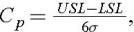
Process capability indices, which establish the relationships between the actual process performance and the manufacturing specifications, have been a focus of research in quality assurance and process capability analysis for the last 20 years. Capability indices that qualify process potential and process performance are practical tools for successful quality improvement activities and quality program implementation. Apparently, the first process capability index to appear in the literature is the precision index C p, defined by Kane (1986) as:


where USL is the upper specification limit, LSL is the lower specification limit, and a is the process standard deviation (see Figure. 1.1.). To avoid confusion with the C p-Mallow statistic the index is occasionally denoted by S p. The numerator of C p provides the range over which the process measurements are acceptable. The denominator gives the range over which the process is actually varying. The index C p was designed to measure the magnitude of the overall process variation relative to the manufacturing tolerance, which is to be used for processes based on data that are normal, independent, and in the statistical control. Obviously, it is desirable to have a C p as large as possible; small values of C p (particularly those less than 1.00) are not acceptable because this would indicate that the natural range of variation of the process does not fit (probably exceeds) within the tolerance band. Finley...

UNLIMITED FREE
ACCESS
TO THE WORLD'S BEST IDEAS

SUBMIT
Already a GlobalSpec user? Log in.

This is embarrasing...

An error occurred while processing the form. Please try again in a few minutes.

Customize Your GlobalSpec Experience

Category: Gradient Index Lenses
Finish!
Privacy Policy

This is embarrasing...

An error occurred while processing the form. Please try again in a few minutes.