Encyclopedia and Handbook of Process Capability Indices: A Comprehensive Exposition of Quality Control Measures
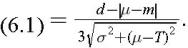
In the previous Chapters we have concentrated on the three basic indices C p, C pk and C pm. The indices are interrelated but each one has it specific properties. Under the normal assumption the distributional properties of estimators of this indices are established without great difficulties and we have by now rather a complete picture of their properties. Pearn et al. (1992) proposed the process capability index C pmk, which combines the merits of three earlier indices. The index C pmk alerts the user when the process variance increases and the process mean deviates from its target value (or both). The index C pmk, sometimes referred to as the "third-generation capability index", has been defined as follows:
where as above USL and LSL are the upper and the lower specification limits, respectively, ? is the process mean and ? is the process standard deviation, T is the target value, d = (USL LSL)/2 is the half length of the specification interval, m = (USL + LSL)/2 is the mid-point between the lower and the upper specification limits.
Comparing the pair of indices (C pmk, C pm), similarly to (C pk, C p), we have the relation C pmk = C pm C a and hence C pmk