Encyclopedia and Handbook of Process Capability Indices: A Comprehensive Exposition of Quality Control Measures

10.3: The Cpm Index for Asymmetric Tolerances

10.3 The C pm Index for Asymmetric Tolerances

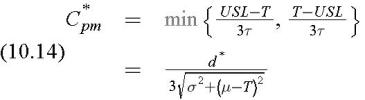
Recall (Chapter 4, Section 1) that Chan et al. (1988) proposed the capability index C pm using in the denominator ? 2 = E(X T) 2 instead of ? 2 = E(X ?) 2. This index takes into account the proximity of the process mean to the target value and as well as the process variation. For asymmetric cases ( USL-T ? T LSL), Chan et al. (1988) modified C pm as follows. Simply shift appropriately one of the two specification limits, so that the new (shifted) specification limits are now become symmetric with respect to the target value T:


where as above d * = min{D u, D l}, D u =USL ? T, and Dl =T ? LSL. Obviously, if D u =D l, then T = M = (USL + LSL)/2 and d * = d =(USL ? LSL)/2, the specification tolerance becomes symmetric and the index C * pm defined in (10.14) reduces to the original index C pm defined in Equation (4.1).

Boyles (1994) also notes that this generalization could understate process capability by restricting the process to a proper subset of the actual specification range. For the two processes E and F with ?? E < T, and ? F > T ?

UNLIMITED FREE
ACCESS
TO THE WORLD'S BEST IDEAS

SUBMIT
Already a GlobalSpec user? Log in.

This is embarrasing...

An error occurred while processing the form. Please try again in a few minutes.

Customize Your GlobalSpec Experience

Category: Cyclone Separators
Finish!
Privacy Policy

This is embarrasing...

An error occurred while processing the form. Please try again in a few minutes.