Encyclopedia and Handbook of Process Capability Indices: A Comprehensive Exposition of Quality Control Measures
We hope that by now our readers are familiar with a number of process capability indices (including C p, C pk., C pm and C pmk) that have been commonly used in the manufacturing industry to measure whether a process is capable of reproducing product items within the specified manufacturing tolerance. However the indices described earlier are appropriate measures only for processes with two-sided specifications only (which require specifying both USL and LSL). For the unilateral tolerance situation where only one specification limit is provided, Kane (1986) one of the early pioneers of process capability studies considered the following indices
where USL and LSL are as above the upper and lower specification limits, respectively, ? is the process mean, and ? is the process standard deviation. The index Cpu measures the capability of a "smaller-the-better" process with an upper specification limit USL, while the index C PL measures the capability of a "larger-the-better" process with a lower specification limit LSL.
Process yield measure based on C PU and C PI
For normally distributed processes with one-sided specification limit USL, the process yield is given by
where the variable Z follows the standard normal distribution N(0, 1) with the c.d.f.
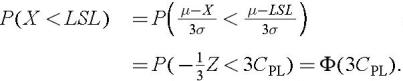
. Similarly, for normally distributed processes with one-sided specification limit LSL, the process yield is
For convenience of the presentation, we let Cj