GaN-Based Materials and Devices: Growth, Fabrication, Characterization and Performance
In electrically biased semiconductors and their heterostructures, the distribution of nonequilibrium electrons in the momentum space determines the basic electric properties. Assuming that in a general case there are several actual energy valleys in the conduction band,13 ,25 we introduce the distribution function
, where the subscript l denotes different energy valleys,
and
are the electron momentum-and real-space coordinates, and t is the time. Then, the Boltzmann transport equation for f l can be written as
| (1) | |
Here E l(
) and
are the kinetic energy and the velocity of electrons in the valley l, and U(
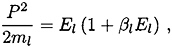
) is the potential energy. In moderate electric fields, when the electron energy spectrum may be assumed to be parabolic, we will use the simple relation E l =P 2/2 m l with the electron effective mass m l in the valley l. For the electron transport under high fields and high electron energies, we shall take into account the nonparabolicity of the energy spectrum and use the Kane formula for a spherical valley relating P and E l :
| (2) | |
with the nonparabolicity parameter ? l.
The right-hand side of the Boltzmann equation [Eq. (1)] is the collision integral. The latter, in general, includes both intravalley and intervalley scattering:
| (3) | |
Also it is convenient to formally distinguish contributions from the e-e collisions and the scattering by phonons, possible crystal imperfections, etc.:
| (4) |