4.1. Basic equations
The cases with high electron concentrations are the most typical for group III-nitrides and their heterostructures. Under such conditions, e-e collisions dominate over all other scattering processes in Eqs. (3) and (4). Accordingly, the Boltzmann equation may be solved as follows.
In the first approximation, one may consider only the e-e terms and neglect all the other terms in the transport equations. This gives the set of equations:
The equations can be satisfied by a shifted Fermi-Dirac function with two arbitrary parameters T e and V dr, which have the meaning of the electron temperature and the drift velocity. For nondegenerate electrons, we obtain:
| (8) | 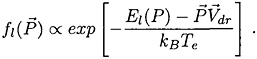
|
Intensive momentum and energy exchange between the electrons in different valleys establishes the distributions with the same T e and V dr. Note that the form of Eq. (8) is valid for an arbitrary electron dispersion E l (P), including the nonparabolic dependence of Eq. (2).
The parameters T e and V dr are to be found from the momentum and energy balance equations, which can be obtained by multiplying Eq. (1) by P z and E l (P), respectively, followed by integrating and summing them over  and l. As a result, the leading terms
  are cancelled, while the other terms contribute to the momentum and energy balances. For a spatially uniform problem, these equations are
| (9) | 
|
| (10) | 
|
where the dimensionless parameters ?=k B

 TABLE OF CONTENTS